
Our public services are in crisis. Rochdale’s Good Help Movement holds the key to solving it
“We got on the phone to each other, talking about everything it [the cost of living] was doing and we said, you know – we’re just not having it. We talked about a lot of different things we could do but the bottom line was – however bad this is, we’re not going to just accept it.” Helen Davies, Prevention Lead, Rochdale Borough Council
There's been a revolution in Rochdale. You'd be forgiven for not noticing it because, unusually for a revolution, it started in local government. Beginning in 2019 as a movement to transform public services, in under a decade it has spread across the public sector in this part of Greater Manchester, from high-level strategy to frontline delivery, affecting every resident in ways both large and small.
It's remarkable that something with the potential to reshape how we think about our shared resources has arrived with so little fanfare. More remarkable still, it has cost next to nothing while saving taxpayers millions. It was led by a handful of skilled, determined public servants and required no expensive consultants, glossy strategy papers, public announcements or, crucially, permission. Unless you live or work in Rochdale, you probably have no idea this has happened, or that it has the potential to improve all our lives.
Six years ago, like local authorities across the country, Rochdale Borough Council faced the global pandemic. Already under severe financial pressure, it would have been easy to do what many others did: abandon long-term planning and revert to traditional, top-down decision-making.
Instead, on 28 July 2020, while still unable to meet in person, 76 public and third-sector workers gathered online to develop a plan to transform not just a project, department or leadership team, but their entire public service ecosystem using the principles of the then nascent Good Help movement.
Good Help had begun just three years earlier, in 2017, as a partnership between Nesta and Osca exploring how well public services supported people's ability to take control of their lives—what academics call self-efficacy.
The idea that people need help to make positive change is not new. What Good Help showed was that there is also plenty of 'bad help': support that, at best, creates dependency and limits people's potential, and at worst traps them in cycles of sickness, poverty and crime. Help alone is not enough—how we help each other is what really matters.
So - the £23.3 billion public sector question is: what makes help good or bad?How do we define it, and make sure that the help we provide is actually effective, and not expensively counter-productive?
The Good Help report, launched in 2018, answered this question by speaking to hundreds of public and third sector practitioners, painstakingly distilling decades of on the ground experience into seven universal characteristics of effective support: an accessible, change making checklist that could be used in any location, at any level, and by anyone.
What the report also found was that at the core of truly 'good' help, the kind that actually works, is a simple idea: if you foster the right conditions, people themselves are best placed to lead change in their own lives and communities.
For decades, public services have been treated as linear, technical systems for delivering resources. Yet this is not how they actually operate. We've been looking through the wrong end of the telescope. To understand them fully, we must change our perspective, remove the managerial lens, and see them for what they really are: living networks of people helping one another.
This shouldn't be a surprise—it isn't to anyone who has ever needed to help someone or be helped themselves, which is all of us. There is real science here, but it's not the rocket variety. To frontline workers, including myself, the principles of Good Help can feel so obvious that every colleague, carer and council officer I've discussed them with over the last eight years has responded as though I were asking how to make a cup of tea.
But when I ask those same people what bad help looks like, they describe the same frustrations: box ticking, unnecessary admin, meaningless targets, doing things just because 'it's the way it's done', and a culture of opaque, punitive decision-making.
“Everywhere you look, you see money wasted when it could be invested in things that are shown to really work, the things that actually make change. That’s not going ‘let’s do a cv, tick, 20 people seen in one month, tick, 40 people seen the next month, tick, tick, tick.’ That’s just a waste of everyone’s time.” Aggie, New Pioneers Employment Support, Rochdale
What they are describing here are in fact our public service structures themselves, as they currently operate.
When help is scaled up from the individual to the regional or national level, when it becomes a system, we lose our ability to understand what really works.Things that are treated as basic common sense in a community centre become naive or impossible in a policy proposal - and it’s costing us our future.
In 2019, Rochdale Council had set out to change that. With the support of Prevention Lead Helen Davies, it was one of 25 local authorities who applied to become a Good Help Place, and plans were already underway to adapt those core principles to Rochdale’s unique public sector landscape, including its Adult Social Services.
And so, when the pandemic arrived, instead of shelving those ‘radical’ plans, Rochdale did something that would surprise only those unfamiliar with its Co-Operative, non-conformist history: it leaned into them. Instead of seeing the Good Help system change as an obstacle to crisis response, they recognised it as the crisis response the moment needed.
For the next two years, in the midst of lockdowns and rapidly changing service demands, Rochdale Council set out on a bold civic gardening project. It mapped the skills of its own communities, it sought out and celebrated the myriad forms of effective work that already existed on the margins of the official system (often without recognition or coordination).
“‘You’re the expert on Good Help, you’ve been doing it for years.’ As soon as I heard that I relaxed and thought – ok, let’s hear them out… It’s been a breath of fresh air when most of the time we’re pushing against a system that more often than not seems to want to stop us doing our job.” Key contributor to the first online workshop.
Its staff worked with people from right across the borough and the sector, training Good Help advocates and co-designing a strategy for bringing this work into the very centre of public service delivery.
Specific projects were selected to trial the Good Help checklist and approach, building both a working model and an engaged movement right across the sector.
“The first conversation is not about – ‘you need to get a job’ – it’s ‘how are you?’ You talk about where they are. We have a scale for that, to give us a framework for how they’re feeling. But it’s only when they define it as good on that scale that you even begin to talk about employment.” Mark, New Pioneers employment broker
As the pandemic moved into a cost of living crisis, the movement continued to grow and change. It did not look the same in every place, and it was not a set of rules to be ‘policed’ - instead it was forged through conversations and trust, and existed not in neat outcomes charts, but in the messy spaces between goals and reality. A fluid, adaptable feedback system was developed allowing people to acknowledge what was difficult, and build only on what really works, as defined by them.
“Even when things aren’t going right, Good Help is a lens to look at how things could be different. And when things are going well, it’s another lens to look at success in a way that doesn’t pat ourselves on the back for fixing things and being a hero. It’s about looking deeply at someone’s life and realising there are always opportunities to do Good Help. And in many cases we won’t see what bad things we’ve prevented but still, twenty years later that person won’t be in a mess.” Sally Cook, Rochdale Borough Council
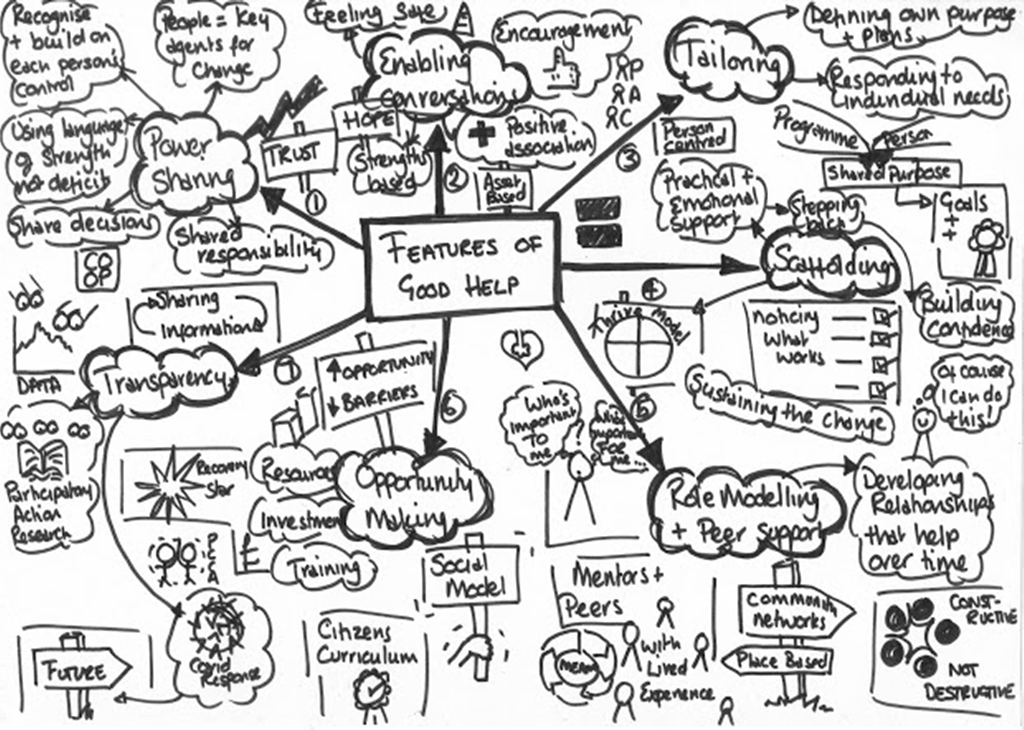
The results have been transformative.
By 2023, more than 350 trained advocates were providing 2,500 hours of Good Help conversations every month, effectively supporting over 5,000 people to improve their life circumstances in meaningful ways. Six key strategy documents have been created with Good Help at their heart, embedding its principles beyond any particular management period. This is a place where community projects operate on trust, with targets set only by the people they serve; where call centres operate on 'human first' principles, explicitly valuing time spent understanding callers' wider circumstances; where conversation and making a brew are (openly) valued over assessment forms; where NHS staff give talks at schools so children feel healthcare roles are possible for them; a borough with Prevention Officers, not just Support Workers; and where collaboration and power sharing are on the agenda. Rochdale is a place where (and this is the one that always gets a gasp from hard pressed frontline colleagues) council strategy documents begin with poetry.
Good Help has permanently shifted the dial in Rochdale, from a culture of measurable targets defined from the top down (there’s that box ticking again) to a preference for indicators, collaboration, and a way of working that is inherently preventative rather than responsive.
“What was apparent was that people quickly don’t feel they need to measure [Good Help] because they can see and know that it’s working. They felt better, and nobody asks to have this measured… [Good Help] is like kindness or politeness, this can slip under pressure, but we instinctively know that it’s better. Helen Davies, Prevention Lead, Rochdale Borough Council
We all know what a false economy is, and we all understand that preventative work is more important in a crisis, not less. It’s also counter-intuitive and hard to measure, which is why it’s usually the first baby to be thrown out with the cost of living bathwater. Any support worker will tell you that for people under pressure, everything is now. With scarcity thinking, the first thing you lose is the future. And what’s true for individuals, is true for local authorities. Few systems meaningfully consider the value of the things that haven’t happened - the jobs not lost, the tenants not evicted, the crimes not committed - particularly when resources are scarce. It requires a strong, shared culture to keep planning for the future, even when the present is so pressing. If we are looking for the toolkit that allows us to practically imagine better futures (and we should be) - then here it is.
And if it is measurable outcomes you need, then you could do worse than to look at one marker of Good Help’s success: the wellbeing of employees, now through the roof in Rochdale, as measured quantitatively in increased in staff retention, and qualitatively, Good Help style, through conversation. This is not just a question of morale as a nice to have. Across the UK, burnt out public service employees are leaving the sector in record numbers. According to the LGA Workforce Strategy Survey (2025), 94% of councils currently report difficulty with recruitment and retention, and around one-third of UK public sector workers have either taken steps to leave or are actively considering it). This hemorrhaging of experience is creating a skills gap that is rapidly worsening the sector’s ability to meet the challenges of the future.
“An important difference to note is the impact on the workforce and the liberation that comes with this approach. You hear phrases like, “Oh I’m now doing what I came into this job for after X number of years.” People are also able to connect with other parts of the system that might have been difficult to do before. So there’s a kind of humanising that goes on in the system.” Helen Davies, Rochdale Borough Council
“We don’t experience burnout because there isn’t a barrier between us and who we work with – we socialise with the volunteers, and it’s a joy for us. We all enjoy hanging out together, that’s our choice. This role is a privilege because we get to really do what’s important.” Nicola, New Pioneers Broker
Eight years on, Good Help is needed more now than ever. After years of austerity, centralisation, rising costs, and an unprecedented, global health emergency, nearly all public services are performing worse now than they were on the eve of the pandemic.
According to the Local Government Association’s October 2024 survey, one in four councils say they will likely require emergency government bailouts to avoid insolvency by 2027. For councils with social care responsibilities, this figure rises to 44%.
As I write this, public service structures are buckling under the strain of an extreme weather event, with such pressures set to increase in frequency and severity over the coming decades.
The system is no longer creaking, it is failing, and rapidly.
But what we have learned in these eight difficult, extraordinary years is that we do not have to accept decline as inevitable. Those who will not only survive the new reality unfolding around us, but thrive, are those who keep asking the right question. That question is not, "What do we lack?" but, "Where are we rich?"
Our wealth lies in the skills, resources and resilience of the people who make up our communities. Good Help already exists everywhere. As the state has receded, effective community work has not withered—it has flourished. Good Help should not exist in spite of the system; it should be the system.
Now more than ever, we must reject short-term thinking and sticking plasters, and instead have the courage to focus on the golden threads of human connection beneath our service landscape. This is the wealth we rest on. Like Rochdale, we must learn to see it, map it, create the conditions for it to grow, and allow it to transform our future.
